

John Towndrow from Reading (Part 2)
When John mentioned he was born in Reading (home of The MERL) we got even more excited and we invited John to tell us a bit more
Life as a child in England (Before Immigration)
My memories of life as a child in England are varied. I lived in a lovely rowhouse at 22 Warwick Road, Reading, England. The house is still there, and I have very fond memories of that place being able to roam from the back garden into a neighbouring park and having a short walk to school. My friends and I would often go what was called egging, that is, collecting bird eggs and making up a collection in egg cartons.
They were all so beautiful from the tiny wren egg to the large kestrels. We were careful to only take one egg from an egg nest. I don’t think that would be very acceptable today. I was also free to roam around on my bicycle. I also rode on my father’s bike when he went to his nearby allotment Garden.
On the weekends we had the excitement of my father biking off to a nearby garage to pick up our beautiful car, loaded up with camping gear, and head off to an event organized by the Camping Club of Great Britain and Ireland.
These were events held in large farmer’s fields where hundreds of tents, big bonfires, games, races and sing songs would be very common. There was a lot of friendly competition among people making special boxes to hold all their camping gear, cleverly organized to fit into the small cars that we all had. Everyone was camping in tents and there was much disdain for the people in other clubs that used caravans. These folks were seen as being a bit too soft to camp under canvas.
Another wonderful memory was going to Switzerland for our summer holidays. It was much cheaper to vacation on the continent than in England in those days. The journey would start with the drive to the coast, and I can still remember the excitement of coming up over a hill and seeing the sea in full view.
Our car was hoisted onto the ferry with huge straps under the chassis – the start of a grand adventure. We always stayed at a lovely hotel and one of my fondest memories was the food. I can still recall the wonderful aromas that filled the dining room and often the platters came with huge silver domes that were removed with a flourish. We would fish in Lake Geneva and once my father caught a beautiful trout. The hotel chef was kind enough to cook it for us and present it in the most imaginative way surrounded by decorative vegetables.
We also climbed the mountain called the Rigi and the hotel would send us off with something called a Rigi sandwich which was a multi-layered sandwich to keep one going on the long hike. Another special highlight was to come across an elderly man on the mountain path who would blow his alphorn – a long horn that stretched right across the path, so we had to step over it on our way. The long mournful sound has long been a tool used by shepherds to call the cows from the pastures and into the barn at milking time. Of course, that sound was followed by the clackety clank of the cows with their bells heading home.
One funny incident I was told about by my mother. When I was very little, we were heading home but my mother told my sister and I not to move – she had to go back into the hotel for a few minutes. We were all dressed in our white summer clothes and somehow, we managed to innocently wander off to look at the nearby cows. As fate would have it, I managed to slip into the cow manure and was covered from head to toe. Another grand treat was to get ice cream which was so deliciously icy.
Another interesting memory was of the toilets. It was common in Switzerland to have two-foot plates to stand on rather than a toilet to sit on. You can imagine getting a small child to step on the plates and squat down was quite the challenge.
My Parents
It’s perhaps appropriate to say a bit more about my parents. My mum, Pearl Irene Unwin was the eldest and was a strong woman with definite views on her family. She worked in my grandmother’s wool shop and was very good at her job. She was an expert knitter, and she won prizes for her window dressing to attract customers.
Since she worked during the day, we had a woman, Mrs. Purdy, who cleaned and prepared tea for Trish and me when we came home from school. We got into trouble one day when we locked her in the stair cupboard. I remember riding on her back while she scrubbed the floor.
Mum was always ready to defend us - for example, we were baptised in the Anglican church but if she didn’t agree with some of the teachings, she just pulled us out of Sunday school. She did struggle with her mother - feeling that control all her life - torn between being loyal to her and protesting her self-centred, controlling ways. Rosie, for example, ignored our family and would not say a formal goodbye when we left for Canada.
Mum was very fastidious about how we were turned out in public. We always had clean, practical clothes - the best that we could afford - always opting for fewer but higher quality choices. She emphasized that how we looked affected the way we felt about ourselves. I was always very sure of her love for me as she put us first in all the decisions she made as well as encouraging us to talk about any issues we had, listening carefully and helping to come to practical solutions. She was definitely the planner in the family, the one who drove decisions and long-term plans.
My dad, Albert Gainsford Towndrow, was more introverted. He had a high level of skill in making things. He spent the customary seven-year apprenticeship as a pattern maker and was always in the process of creating things - whether in metal or wood and later in glass. His hands were as steady at 80 years old as they were as a teenager. He was not someone who was demonstrative in his affections, which was something my mother was a bit regretful of, but she was grateful for his many other qualities - strong, steady work ethic and devoted to his family and a life-long learner, willing to tackle any practical problem.
When he was a teenager, he was a Boy Scout and was given a medal for bravery by Lord Baden Powell for saving a boy from drowning in the River Thames.
From an early age, he drove motorcycles and even competed in events that had him jumping through fiery hoops. It is a family legend that he broke every bone in his body at one time but I’m not sure if that was apocryphal. I do know that he spent a year in hospital after falling off his bike when the wheels got stuck in trolley tracks. Apparently, he had bone tuberculosis. I suppose moving to Canada was not such a dramatic decision for him after all.
Decision to Immigrate
It was 1955, I was nine years old and living with my parents at 22 Warwick Road, Reading, when I first found out that we were thinking of immigrating to another country. My parents were quiet about any big changes because they didn’t want to get us upset. My sister, who was a teenager, or almost a teenager at the time, was not happy at the prospect. She had a dog and a cat that she loved, places to go to ride horses and lots of friends. I was only nine and sure, I had friends, but being a boy, I was also interested in adventure and so it was less problematic for me.
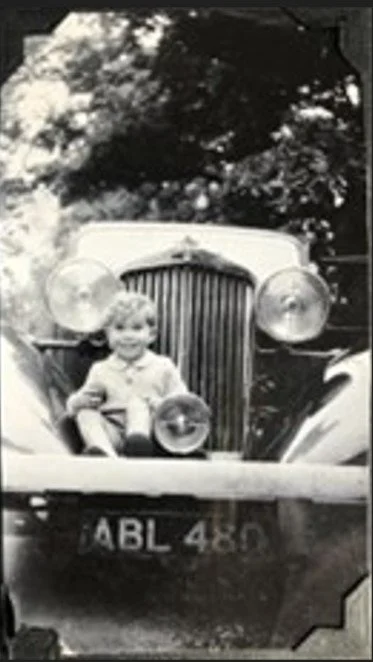
I’m not sure what triggered the discussion in our family, but it was the post war period, and I think my father Albert Towndrow was getting a little itchy in his job. He had worked very hard for a company called Robert Cort and Son Ltd. and he invented a couple of major new gas valves. These were valves that were able to work despite the dirty coal gas that was running through them, so they were a major breakthrough for the company he worked for. The company kept promising that he would get royalties for his invention but each time he asked they had excuses for why it wasn’t quite the time for that. So, one day he came home and told my mother that he had resigned.
This was a big shock because in those days people tended to stay with one company for their whole career and security was a very valuable thing to have. England was still using food rationing stamps, so things are not exactly smooth in the country.
Once the decision had been made there were a lot of logistics to take care of. Should he look for a new job? Should we think about going abroad as many people are doing? Also brewing in the background was the fact that my mother, Pearl Towndrow, along with my aunt Iris, worked for their mother, Rosie Unwin, in her wool shop. That was fine, but my grandmother was taking advantage of her two daughters, not paying them very well but promising them that they would benefit from having shares in the company. The longer this went on, the longer my mother realized she was probably not going to benefit from these shares. She would just be expected to work for minimal wages.
Coincidentally at this time there was a scheme to attract new immigrants to Australia. The idea was that your passage was paid for, and you would be guaranteed a job when you got there. So, my parents signed up and began the process of dissolving their household. This was hard because my mother and father had worked for a long time to create a home. We had a lovely townhouse in a nice residential area of Reading, all the furniture we needed and of course all the usual treasures that families who have been together for more than a decade have collected.
With my sister having the life she wanted with her animals, her Pony Club and her friends, and me being free to roam on my bike all over the neighbourhood, playing football, looking for birds’ nests, being part of a cub pack, playing with my friends and doing well enough at school, our lives seemed pretty set with nothing else to wish for.
As we know, children basically go along with their parent’s decisions, assuming all will be for the best. My sister, being a little older, tended to push back a little bit but in the end, we had to go along with the plan.
So, we were booked to sail on a ship to Australia and I think a few weeks before we were to go my father got cold feet because the clause that required him to stay in a job for two years, I think, kind of spooked him. He had left his job in England for not being treated fairly and he did not want to be tied to a job again. It’s also possible that he found out that there were probably lots of jobs in Canada and he could take a chance on getting something of his own choosing when he got here. It would also mean that we were not as far away from our relatives and so there was more of a chance, we could visit them sometime in the future. Remember, we were leaving behind a whole extended family - my two grandmothers, one grandfather, three aunts and two uncles and their spouses along with eight cousins.
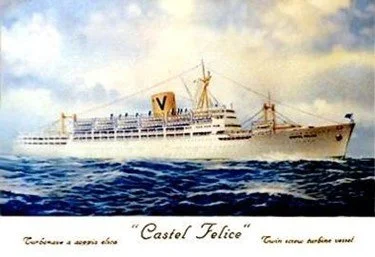
With the decision to change our plan and go to Canada we needed to book a new passage. We were set to go to Canada in late June on a boat called the Empress of England. Unfortunately, there was a strike of dock workers and stevedores which involved a dispute between two rival unions — the National Amalgamated Stevedores and Dockers Union (which struck), and the Transport and General Workers Union, and our boat remained tied up at the dock. Somehow, we were able to change our passage to a ship called the Castel Felice, an Italian ship of the Sitmar Line which was about two thirds the size. My mother said it looked like a lifeboat, however, I’m sure my parents were glad to have this option as they had pretty much disposed of all their belongings and the rest was packed in boxes to go to Canada.
This, of course, presented another dilemma. We had virtually no clothes for the boat or to tide us over when we arrived in Canada. All the boxes were tied up in the strike. I remember well, my mother rushing through Marks and Spencer’s grabbing clothes and underwear for us all to take with us.
The voyage was a mixed experience, being a rough sea we all were a bit seasick and not able to eat very well. I think my sister Trish and I were less affected, so we were able to roam around the ship to our hearts content playing with some toys and playing games and having fun with the Italian staff. The food was OK however we were not quite used to Italian meals, so it took a bit of getting used to. It is fun to see the farewell dinner menu was very British.
There was a swimming pool on board the ship but since there were many extra people on board and the crossing was quite rough, they used the pool as a place to store all the extra luggage.
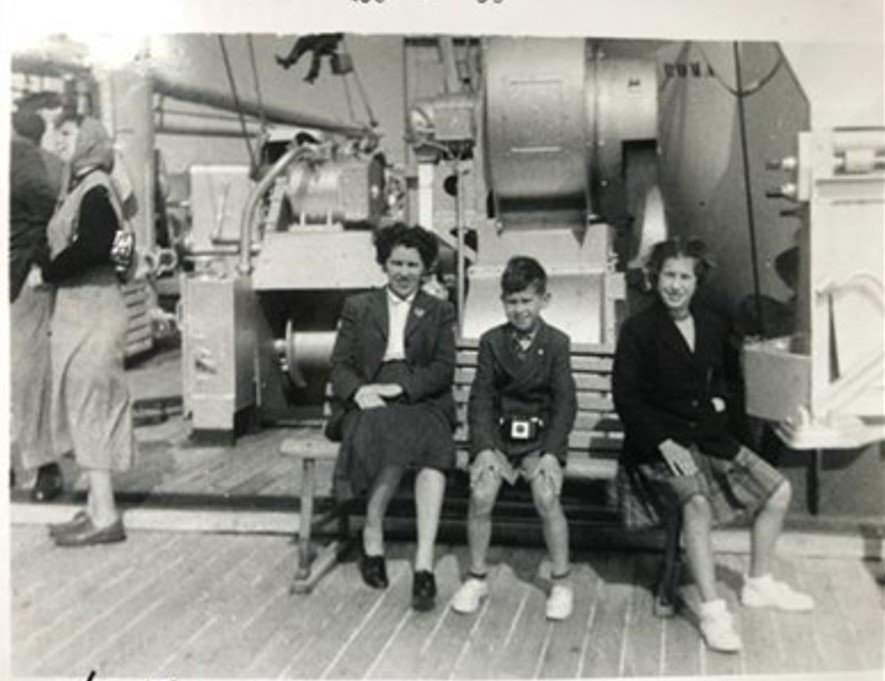
The Towndrow family sailing to Canada
Beginning Life in Canada
Once we arrived in Hamilton my father had a job lined up with A.V. Roe, I believe because of his past work with the company in England called Miles Aircraft. He borrowed a car and drove to the job interview in Malton, Ontario where A.V. Roe Canada had a plant. This was at a time when Malton was in the middle of nowhere north of Toronto and having always gone to work in England on his bicycle, he could not fathom how he would ever get to work from a home that was miles away. Looking at his diary it seemed he did not like Malton and as it turned out it was a good thing he did not take the job because the AVRO Arrow project that the company was working on, was cancelled some four years later and he would likely have lost his job.
He landed a job in Hamilton with Gas Machinery Corporation, and we were able to rent an apartment downtown. This was long before air-conditioning was common, so our eighth-floor apartment turned into an oven when Hamilton experienced one of the hottest summers on record, with temperatures over 100 degrees F. We had no furniture except our camping equipment, with air mattresses and sleeping bags for bedding. My mother despaired because the cooking ingredients and measurements were all different. I recall her crying when she baked something, assuming that the flour she bought was self-raising, so common in England, was just flour with no baking powder, and of course the baking turned into a brick. Also, during the hottest days of the year with only our British winter woollies and tweeds for clothing, we were all sweltering. All in all, it was a rough start.
Each day my mother bribed me with some money to buy comic books and sent my sister off to the cottage with her friend’s daughters and somehow, we weathered this pretty awful introduction to Canada. One highlight for me was going to the 1955 Boy Scout Jamboree in Niagara-on-the-lake. At the same time my mother was also looking for work and with her experience was able to find work at Eames Department Store in downtown Hamilton. Despite these new beginnings I’m sure if we’d had the money our family would have packed up and gone home.
The nice thing about Canada was that there were lots of work opportunities and so we slowly got back on our feet. We were able to move to a new house in the suburbs of Hamilton on the mountain and gradually build new friendships. Eventually new opportunities opened up and we moved to Kitchener where my father worked for the city as they were busy installing new natural gas infrastructure throughout the city.
All this time I was struggling in school because everything was different, and I did not fit in. I couldn’t skate, I didn’t know what Canadian style football was, I’ve never heard of basketball, and nobody played soccer or cricket. My sister, who we realize now may have been a bit dyslexic also struggled and of course she was still angry at my parents for taking her away from her friends and animals and was still resentful, so my parents enrolled her in a private school which helped a little bit but then that was interrupted again when we moved from Hamilton to Kitchener. With our parent’s constant support and encouragement, however, we managed with our school and were able to make friends.
Despite all the downsides of living in Canada there were some upsides too. First, we were able to buy a small property outside Kitchener and fulfil my sister's dream of having a horse of her own. I was able to have the freedom of living on the farm property, shooting pheasants and rabbits and groundhogs as well as helping my father build a barn and generally develop the farming skills that were needed to live in the country. I was even able to buy a small motorcycle as soon as I turned 16. This gave me the freedom to come and go whenever I wanted to despite living in a country property. I still struggled somewhat with school but after spending seven years in high school I was able to enter university - something that would probably have been impossible had I stayed in England.
Life for my parents was, I think, hard and enjoyable at the same time. They had been able to get out from under a more confined system in England and live life a bit more on their own terms. At the same time with both working and renovating the old country house, time was always precious and money tight. My mother really wanted to be home and not have to go to work every day, so with the help of some money from her mother she set up a dog boarding kennel at home and looked after dogs for people who were going away on holidays. This worked well, and we liked having her home of course but in the background her mother began hounding her to pay back the money and I think that was always a source of stress for her.
This country property was my last home living with my parents. I went off to university and then got married. After a couple of years working, my wife and I went to England to work, and it was an amazing experience to go back to my birthplace as an adult and see it through new eyes.
It’s hard to know how different life would have been if our family had stayed in England. I missed growing up with my cousins, aunts, uncles and grandparents but then I didn’t get drawn into any of the drama that surrounds relatives. I suspect I would have been in a trade and lived a much less intellectual life. Chances are I would not have travelled to North America and yet I would have had more access to Europe. I would have been more confined to the middle class of tradespeople and so generally excluded from professional circles. One of my friends that I made, when I later worked in England, was from the Northeast and had grown up with a Geordie (North-East England) accent. He was an architect and worked hard to get rid of his Geordie accent because he would have been slotted into a lower class. That’s the climate my parents wanted to escape, and my sister and I both benefited from that.
For me, moving to Canada gave me more opportunities because I was not a strong student and would likely not have been able to achieve my A levels to go on to university in the UK. Here in Canada, once I graduated from high school, the Landscape Architecture program at Guelph was of interest because I had both building and drafting skills. I was not initially accepted because the program was full but because of a student dropping out I was offered a spot. The program suited me very well and, unlike high school, I was a much better student and excelled in a program that I found had some relevance. At the time it was easy to earn enough money in the summer break to pay for university, supplemented by the government student grant/loan program and a very small scholarship.
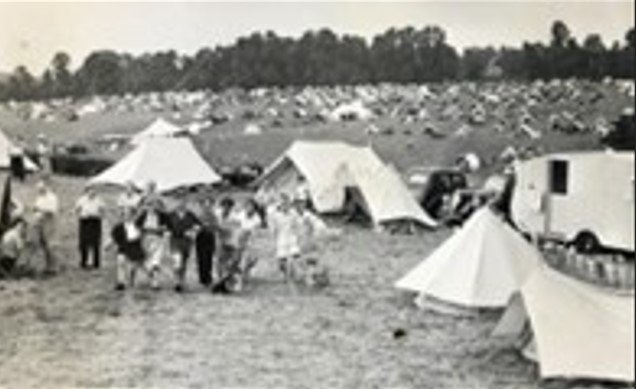
Weekend camping
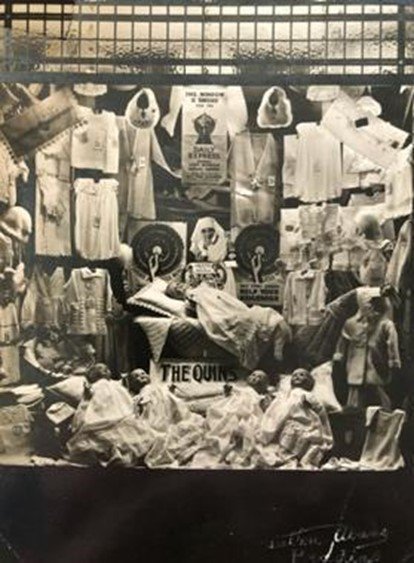
My grandmother owned the wool and sewing shop on the high street in Reading where my mother worked. This is a photo of the shop window display created by Pearl Unwin for the Daily Express Window Display Contest in celebration of the Dionne Quintuplets of Canada. (They were born in May 1934)
The contest had a theme of "Help Your Neighbor”. As I recall she said people in many countries like England, made and sent clothing to help the family.
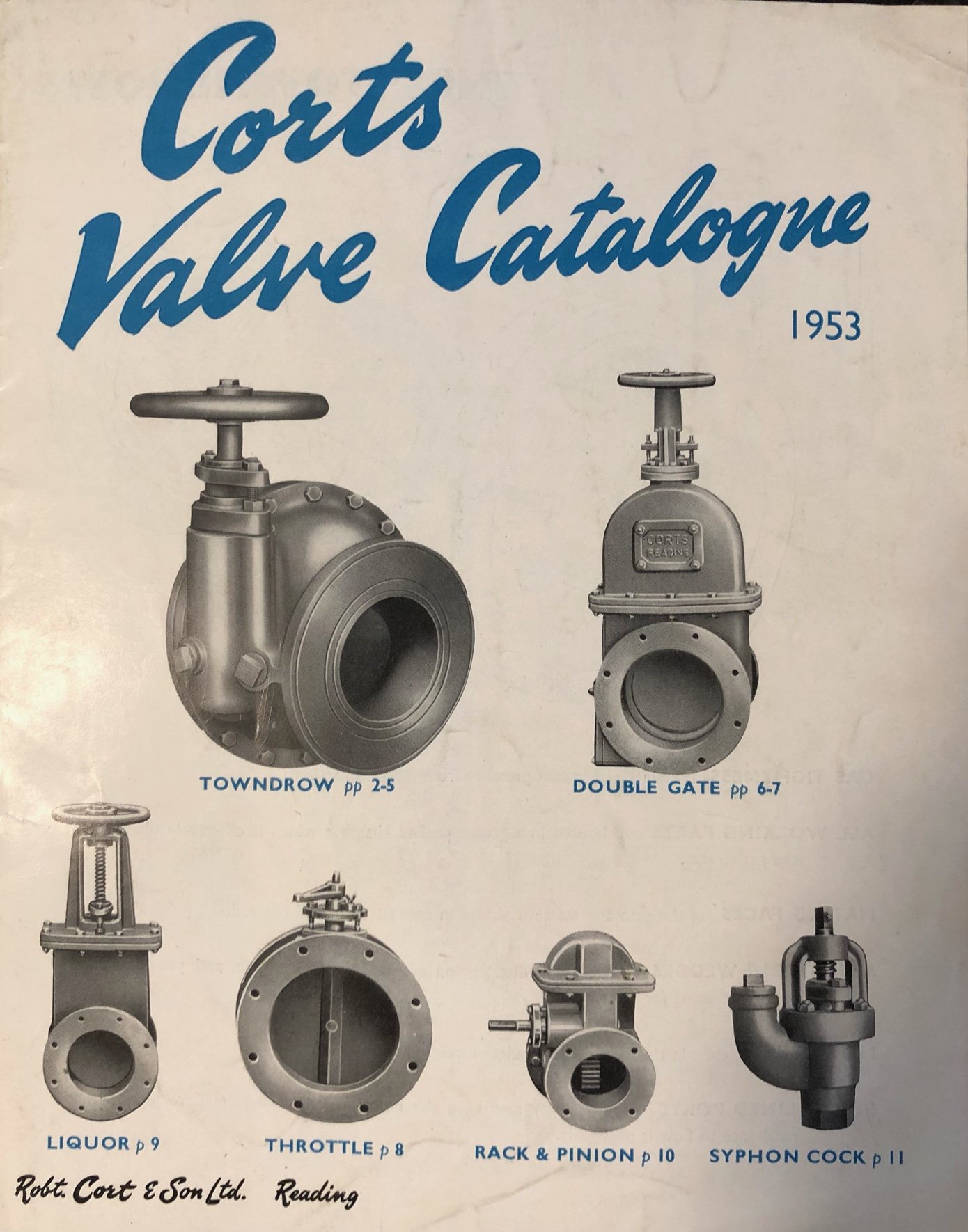
Corts Valve catalogue 1953

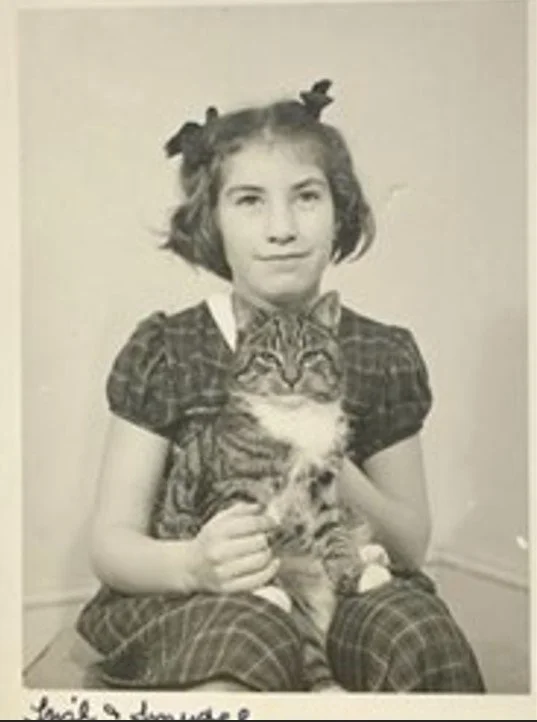
Trish and Smudge
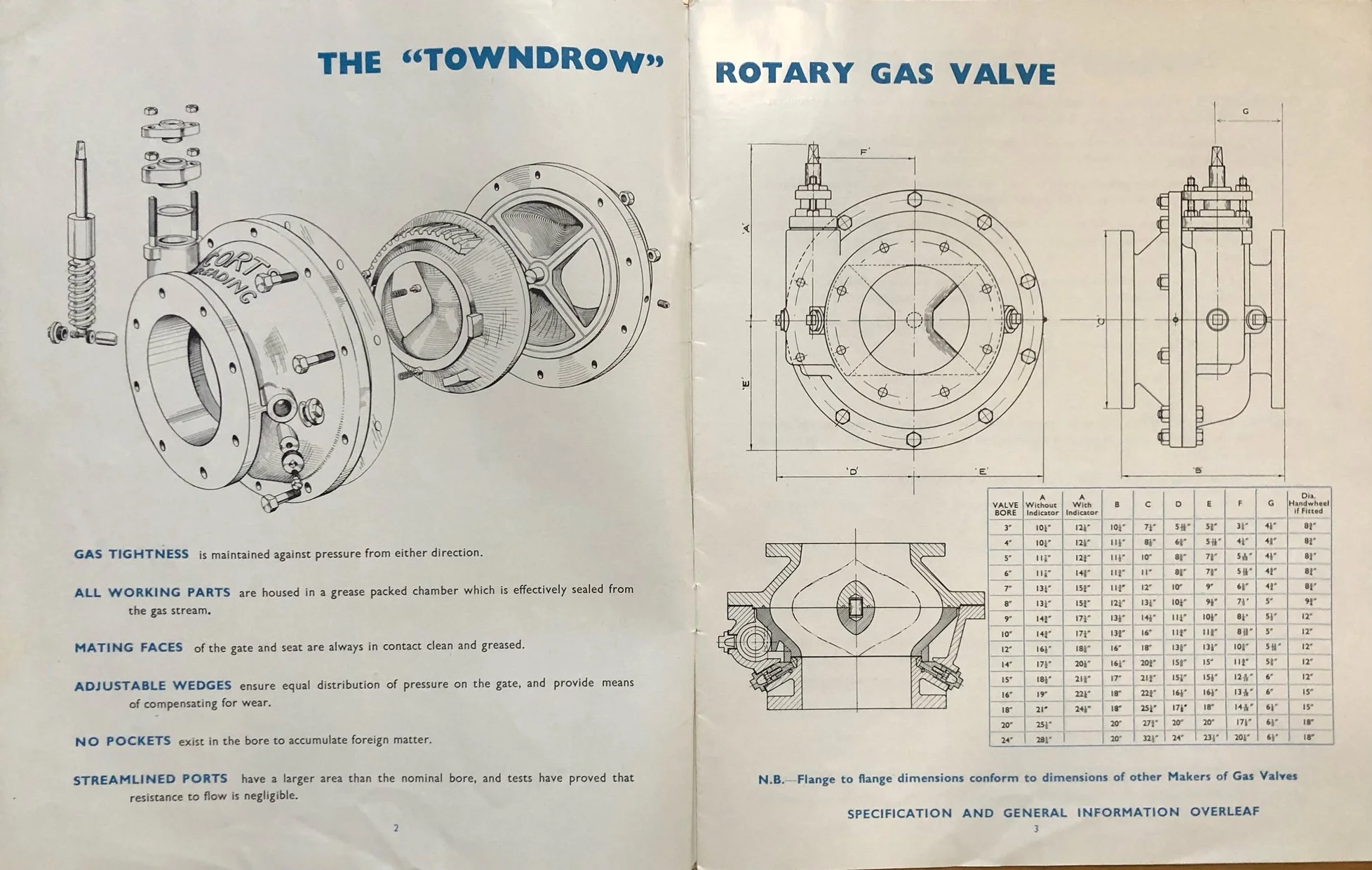
We also had the most beautiful car in the world, I thought. It was a Talbot - a kind of saloon car spiffed up almost like a racing car with wire wheels and British racing green leather seats, flip down mahogany tables at the back of the seat and a sunroof - such a gem. It was modified to appear in car shows. It was tipped up in a show so people could see underneath and the whole bottom was enamelled so it looked very classy from below. It had a special oil pump that you could press every so often to send oil to all the wheels and other moving parts with one swift pump. We used that car to go on camping holidays most weekends and then during the summer it would be loaded onto a ferry that took us to France and Switzerland for our summer vacation. During the week it stayed in a kind of communal garage nearby as both my mother and father biked to work.
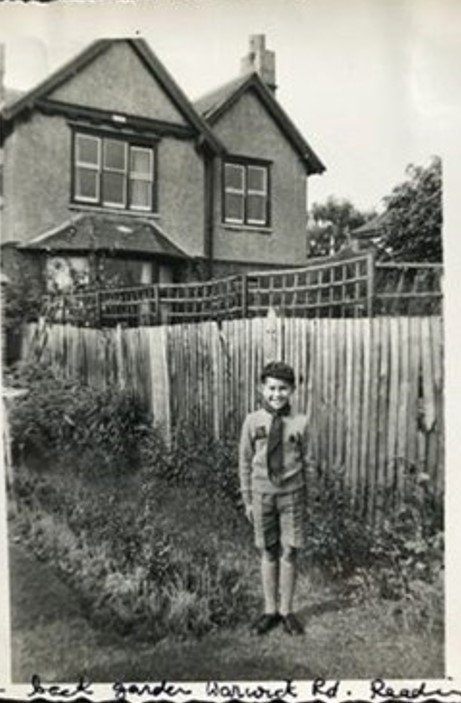
John wearing his boy scout uniform in the back garden at 22 Warwick Rd
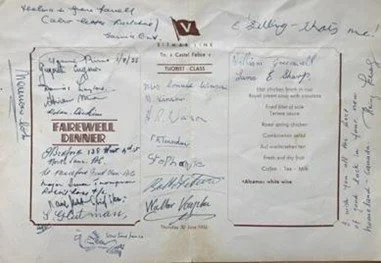
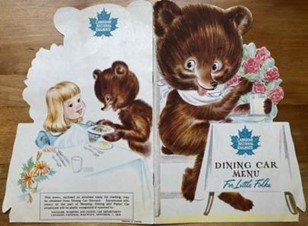
We made some friends on the boat and many of them were like us, immigrants coming to a new land so all a bit nervous and unsure about what was facing us when we arrived. We arrived in Quebec City on what was then Dominion Day - now Canada Day, July 1 and then I think maybe even the same day, we boarded the train for Hamilton. This was at a time when there was a lovely dining car and even a special menu for children. My mother’s childhood friend Irene McFarlane lived there because she had married a Canadian soldier during the war, so it was great to have a place to land in this new country. As it turned out the MacFarlane family was at their summer cottage on Lake Muskoka so we could use their house until we found a place to rent in Hamilton.