

Gardens and Music - ‘Songs for Gertrude Jekyll’
Amongst the delegates attending the 20C Gardens conference (May 2025) at Oxford University Department of Continuing Education organised by The Gardens Trust, was Heather Kerswell. She was the first Independent Chair of the Surrey Hills National Landscape, chief executive of Mole Valley district council, conservation officer at Waverley, Strategic Director for Planning and Development at LB Greenwich, chaired the London Borough Planning Officers Society, town planner and management consultant. During this time she has actively supported the Arts and Crafts Movement in Surrey, has written a monograph on Christopher Hatton Turnor, architect of the Watts Gallery, and is also a member and past chair of the Godalming Choral Society.
Of all the things Heather Kerswell has been involved with, it was an idea connected with this choir that led to FOLAR to invite Heather to write this blog post.

Godalming Choral Society
In 2017 our choir, Godalming Choral Society, was looking to mark its fiftieth birthday in 2018 by commissioning and performing a new choral piece. We chose a young opera composer, Noah Mosley, because we knew he could compose melodiously for voice and set words, either poetry or prose, beautifully. But which words? Noah and I exchanged lots of ideas for suitable poems but nothing seemed right. Then as I was driving up to Busbridge to put a choir poster in the church, lightning struck.

St John the Baptist's Church, Brighton Road, Busbridge, Borough of Waverley, Surrey, Hassocks5489 Creative Commons CC0 1.0 Universal Public Domain Dedication.
In Busbridge churchyard are the Jekyll graves, designed by Lutyens, and Gertrude Jekyll is surely Godalming’s most famous resident. Jekyll! It had to be Jekyll! Suddenly it was clear that the words to be set to music in our piece must come from Jekyll’s writings. These words would be prose but Jekyll’s prose is very poetic. Gertrude herself was very musical, with a fine singing voice which I suspect from her stature would have been alto.

Jekyll family headstones and memorial in the churchyard at St John the Baptist, Busbridge, commemorating Gertrude Jekyll (1843-1932), Agnes Jekyll (1861-1937), Herbert Jekyll (1846-1932) Designed by Edwin Lutyens (1869-1944). photo by Carcharoth - Own work, CC BY-SA 4.0,
pending permission from the NT to show this image : The main flower border at Munstead Wood, Surrey | © National Trust Images/Hugh Mothersole
For most of her long gardening life, Gertrude Jekyll lived in the house created for her by her young friend Edwin Lutyens at Munstead Wood, just outside Godalming in Surrey. Here she developed her own wonderful garden, merging from overflowing herbaceous borders into wood and heathland, which will be well known to many of you. In her rather dark study, she wrote her great books and articles. I started to reread, looking for suitable passages.
Three themes emerged: the flower year, the hardy flower border and her meditation in the primrose copse, a good epilogue. Quite a bit of pruning was needed!
Noah came up with wonderfully appropriate and descriptive settings for a bass soloist, five-part choir and very difficult piano accompaniment, exactly suited to the forces of our choir.
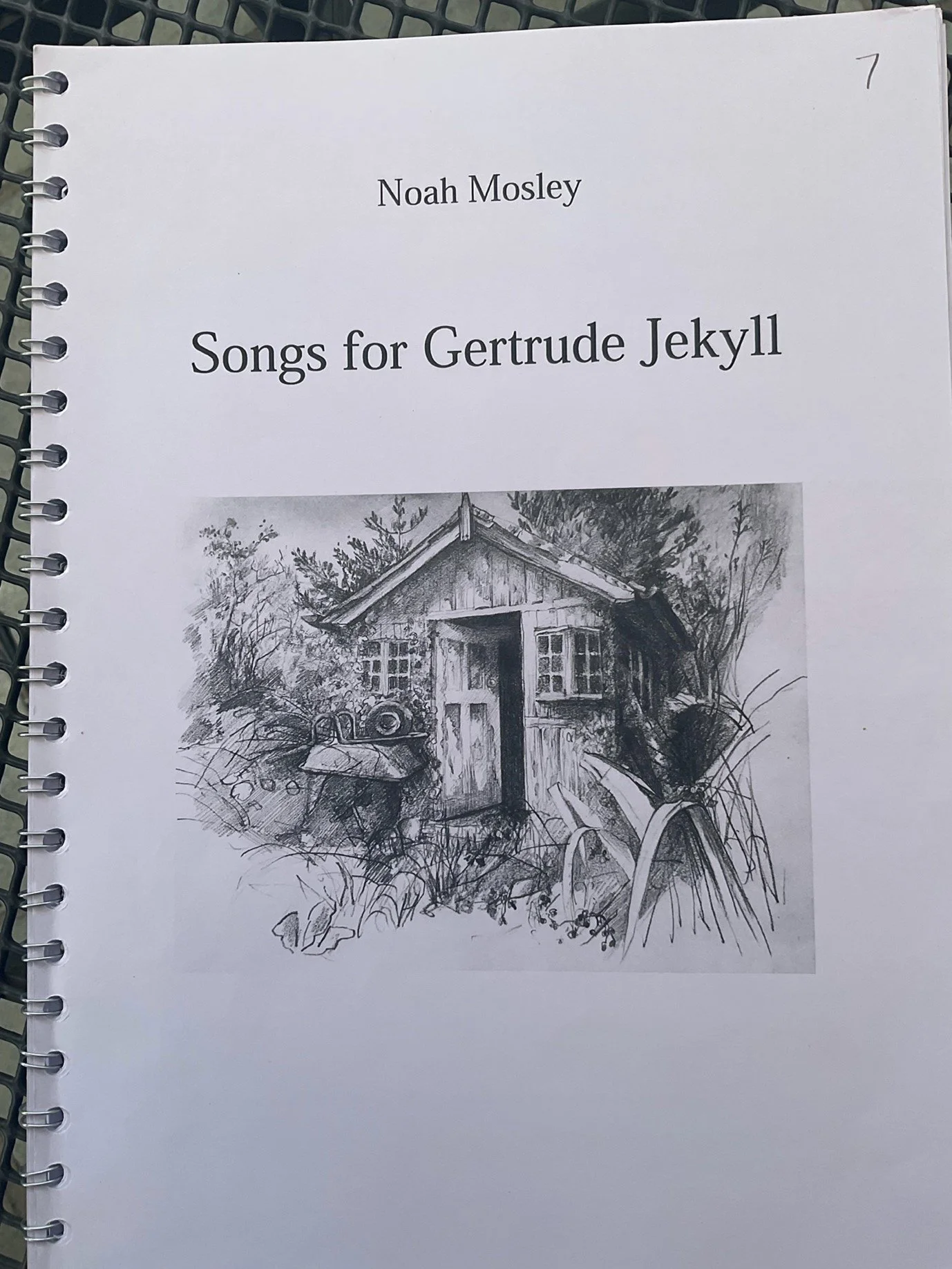
Drawing by Xanthe Mosley
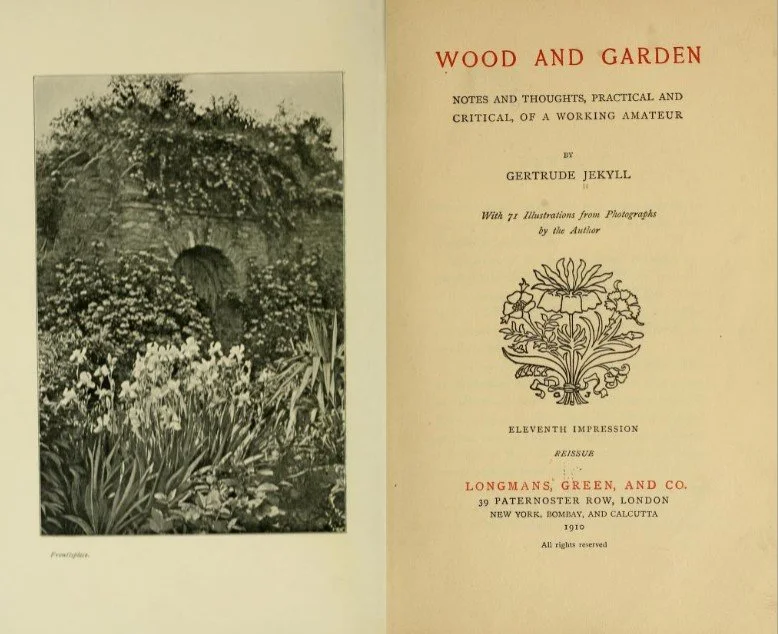
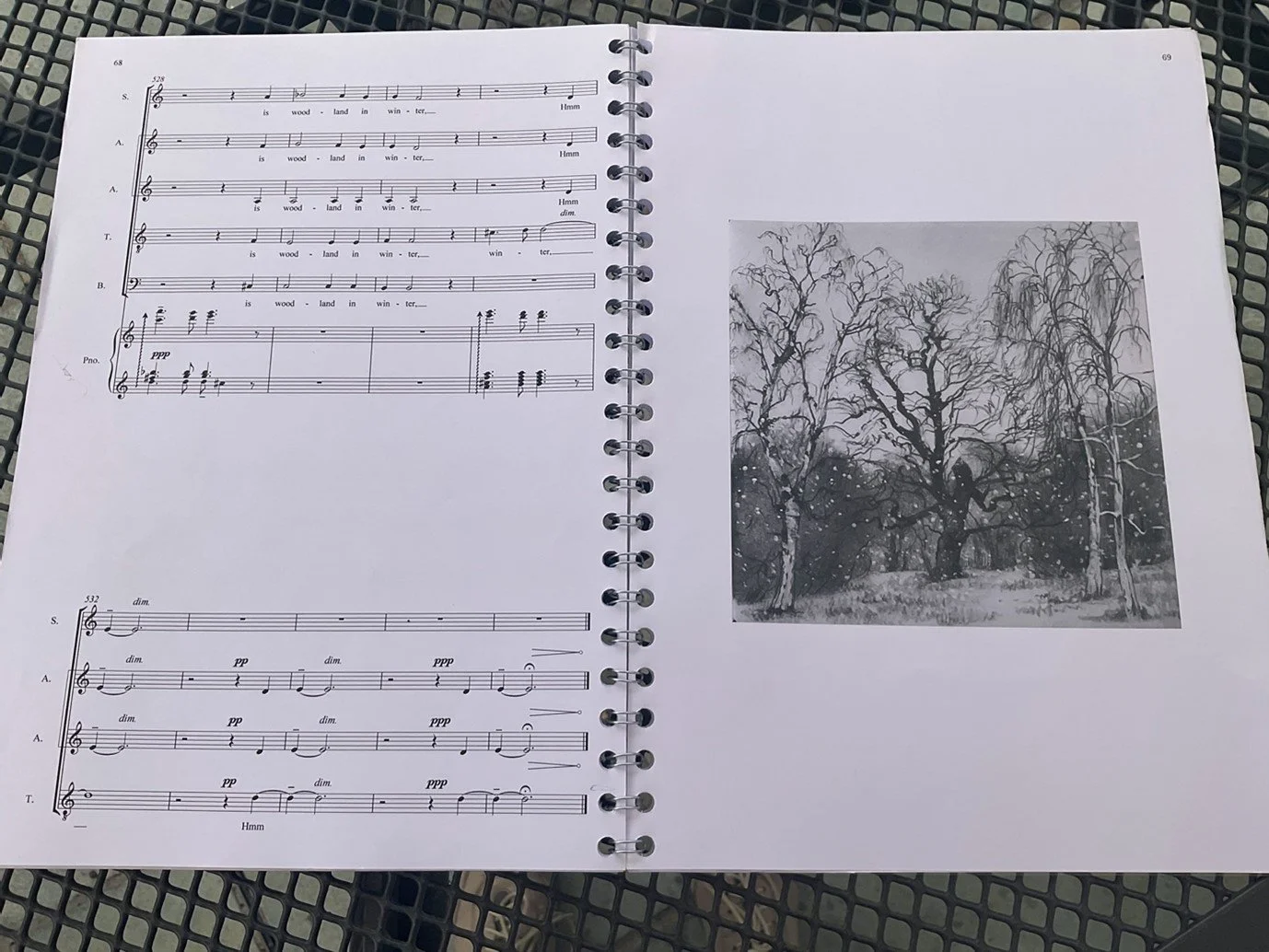
The first song, ‘The Flower Year’, was drawn from lines chosen from Wood and Garden starting with an alto line whispering “A hard frost is upon us” and the bass soloist (our president opera singer Jonathan Veira) voicing ‘How endlessly beautiful is woodland in winter” then amplified by the whole choir. The climax is June: ‘What can I say about June? – the time of perfect young summer…I wander up into the wood and say “June is here- June is here: thank God for lovely June!” Then the September storm…’Fierce gales and heavy rains wrought sad havoc. Dalias were wrecked, their heads lie on the ground…’. Finally, the end of the flower year ‘though the end is a gorgeous one, with its strong yellow masses of sunflowers’, Then, back to winter in a musical sonata form.
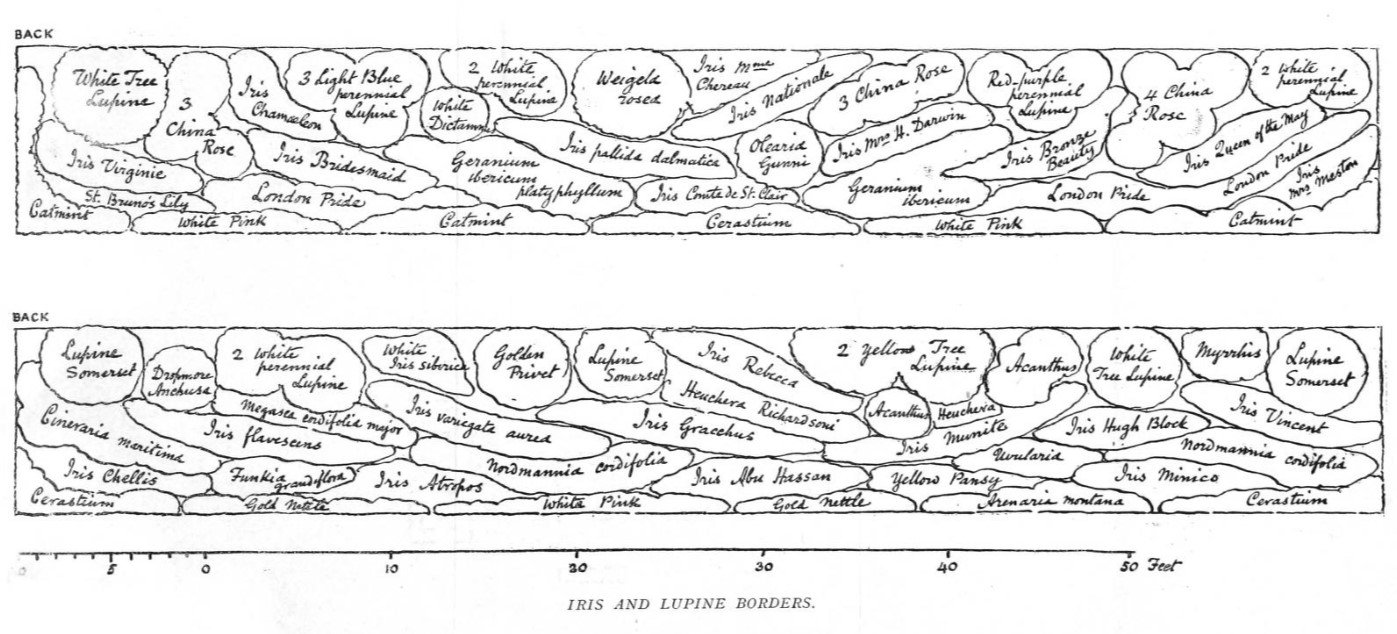
‘Colour Schemes for the Flower Garden’ provided material for the second song ‘The Hardy Flower Border’ which is a musical picture of a Jekyll border. ‘At the western end there are flowers of pure blue, white and palest yellow’. The painting progresses through to ‘the middle space where the colour is strong and gorgeous’ and the music swells. Then the colour recedes again ‘through orange, deep yellow and white to palest pink…pink…pink.’ The music fades away like a Jekyll drift.
The primrose copse was a favourite feature in a Jekyll garden – there is a fine example at Munstead Wood – and it seemed a fitting theme for our last song, taken from ‘A Gardener’s Testament’, a selection of notes and articles from various journals published by Country Life after her death. It is quoted by Betty Massingham in her classic biography of Jekyll. Here is Jekyll’s meditation….’It must have been at about seven years of age that I first learnt to know and love a primrose copse.’ Now elderly and thinking of approaching death, Gertrude remembers each spring, as she wanders into the primrose wood, that the dear God who made all this will give greater new life. She sees it ‘as a never ending parable of life and death and immortality’ and our song ends on those triumphant words. For us Gertrude Jekyll is indeed immortal. Noah’s music for this is a thoughtful and beautiful recitative/chant for the whole choir with an intervention for the bass soloist as the messenger of death.
The choir visited Munstead Wood garden, led round by Annabel the wonderful gardener. We were thrilled to receive the printed score with drawings by Xanthe Mosley, Noah’s mother. Conducted by Sam Hayes, our outstanding music director, we premiered the song cycle in our summer concert of 2018, in the historic hall of Charterhouse school, filled with flowers. We were delighted that Gertrude’s remaining family, Primrose Arnander and her husband, were there. There was a huge ovation for the composer Noah, conductor Sam and soloist Jonathan Veira.
Gertrude Jekyll is the most memorable character in Godalming’s history; she changed garden design around the world for ever. We were proud to celebrate her legacy in a musical tribute. The inscription on her memorial in Busbridge churchyard, designed by Edwin Lutyens, reads
Artist Gardener Craftswoman
and we hope she would have enjoyed our carefully crafted gardening songs.
Heather Kerswell

Noah Mosley
Songs for Gertrude Jekyll, a song cycle by Noah Mosley, 2018
Text drawn from the writings of Gertrude Jekyll
1. The Flower Year. Extracts from Wood and Garden 1899
A hard frost is upon us
How endlessly beautiful is woodland in winter and the forms of the deciduous trees
It is only in winter that I can fully enjoy their splendid structure and design.
At the end of March a day comes, or perhaps a warmer night, when the wind, breathing gently from the south west puts new life into growing things.
There is an innocent charm about the spring flowers….
A marvellous change is wrought in a few hours and plants spring into new life.
What can I say about June?
The time of perfect young summer, the fulfilment of the promise of earlier months, with no sign that its fresh young beauty will ever fade.
I wander up into the woods and say: June is here! June is here! Thank you God for lovely June! Lovely June is here!
Fierce gales and heavy rains of the last days of September wrought sad havoc among the flowers. Dalias were wrecked, their heads lie on the ground, their stems broken down!
Everything looks battered, battered and whipped, whipped and ashamed.
But in a week one would hardly know the garden had been so cruelly torn about.
Towards the end of September the flower year is nearly at an end, though the end is a gorgeous one, with its strong yellow masses of sun flowers, and marigolds, golden rod, a few belated gladioli, the brilliant foliage of Virginia creeper and the strong crimson of the claret vine.
(Reprise) How endlessly beautiful is woodland in winter…..
2. The Hardy Flower Border. Extracts from Colour Schemes for the Flower Garden 1914
The big flower border is sheltered from the north by a solid sandstone wall clothed with evergreen shrubs. The planting shows a distinct scheme of colour.
At the two ends there is a ground work of grey foliage. At the western end there are flowers of pure blue, white, palest yellow, palest pink.
The colouring then passes through stronger yellows to orange and red. In the middle space the colour is strong and gorgeous but as it is in good harmonies it is never garish.
Then the colour recedes through orange, deep yellow, white and palest pink.
But at this, the eastern edge, we have purples and lilacs.
The whole flower border can be seen as one picture, the cool colouring at the ends enhance the brilliant warmth of the middle.
3. The Primrose Copse. From A Gardener’s Testament Country Life 1937, quoted by Betty Massingham in Miss Jekyll Portrait of a Great Gardener 1966
It must have been at about seven years of age that I first learnt to know and love a primrose copse. Since then more than half a century has passed, and yet each spring when I wander into the primrose wood, and see their pale yellow blooms, and smell their sweetest of sweet scents, and feel the warm spring air throbbing with the quickening pulse of new life, and hear the glad notes of the
Birds and the burden of the bees, and see again the same delicate young growths piercing the mossy woodland carpet,
When I see and feel all this, for a moment I am seven years old again, and wandering in the fragrant wood hand-in-hand with the dear God who made it, and who made the child’s mind open wide and receive the enduring happiness of the gracious gift.
So, the impression of the simple sweetness of the primrose wood sank deep into the childish heart and laid, as it were, a foundation stone of immutable belief that a Father in heaven who could make all this, could make even better if He would, when the time should come that his children should be gathered about him!
And as the quick years pass and the body grows old around the still young heart, and the day of death grows ever nearer, with each springtide the sweetest flowers come forth and bloom afresh; and with their coming, with the ever renewing of their gracious gift and still more precious promise; the thought of death becomes like that of a gentle and kindly bearer of tidings, who brings the inevitable message and bids the one for whom it is destined receive it manfully and be of good hope and cheerfulness and remember
That the sender of death is the giver of greater new life no less than of the sweet spring flowers that bloom and die and live again as a never ending parable of life and death and immortality.
Contact for Noah Mosley: email noahmosley@hotmail.com, T: +44(0)7792 493330, W: www.noahmosley.com
NB. FOLAR would love to know if Songs for Gertrude Jekyll are going to be sung in public somewhere - please do let us know info@folar.uk