
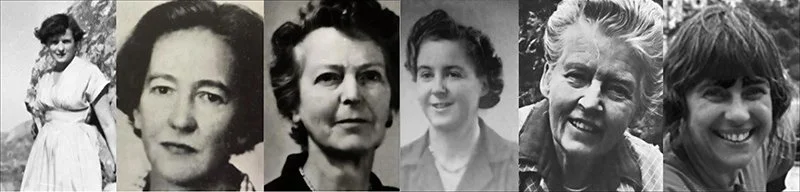
5 Lady Marjory Allen of Hurtwood (1897-1976)
From ILA to diy, how a founder member of the Institute of Landscape Architects came to legitimise mess for the sake of risk
Marjory Allen wrought change through everything she did. Known, by some, for the Selfridges Roof Garden in London – a relatively new concept in garden design in the 1920’s – it was the impetus for the garden which matters most. This beautiful place wasn’t created for wealthy customers but for shop girls who Marjory believed needed, nay deserved, to breath fresh(er) air and rise above the world.
Marjory created gardens and landscapes for famous and wealthy people but she was also a pioneer of spaces for children, not for making beautiful environments for them but for their right to have and make their own places. These Adventure Playgrounds were once described as ‘children’s heaven and adults hell’. It was not how they looked but what they signified and enabled that mattered, essentially risk. Exploring the dichotomy that was Lady Marjory Allen of Hurtwood provides a fascinating insight into the life of a truly remarkable woman.
Through her design and development consultancy WENDY TITMAN has been involved in the creation of environments for children and young people in schools, nurseries and children’s centres in the UK. Her research into the semiotics of children’s environments, published as ‘Special Places, Special People – the hidden curriculum of school grounds’ (1992) led to a period of international work. Prior to this, Wendy was involved with provision for children outside school including the development of adventure playgrounds during which time she had the pleasure of knowing Marjory Allen.
MORE INFORMATION
University of Warwick, Papers of Marjory Allen, Lady Allen of Hurtwood, landscape architect, campaigner for pre-school education and promoter of child welfare, [1914]-1976 - https://mrc-catalogue.warwick.ac.uk/records/LAH
Wellcome Collection, Lady Allen of Hurtwood papers, 1941-1968 Part of: Dally, Ann Gwendolen, and Dally, Peter John https://wellcomecollection.org/works/sbbv8gcb
Contact The MERL for additional information on and by Mary Mitchell in the Institute Journals, membership files etc. merl@reading.ac.uk or telephone +44 (0) 118 378 8660
The Landscape Institute collection at MERL: https://merl.reading.ac.uk/collections/landscape-institute/
More information about FOLAR and joining: https://www.folar.uk
Speaker: Wendy Titman
5 February 2025