
Community Landscapes - Top Down or Bottom Up?
A series of five online talks by FOLAR and the Gardens Trust on different approaches to community engagement with existing and new landscapes.The talks cover historic, contested, cherished, refurbished, political and unloved gardens and landscapes in the UK and overseas, and consider a variety of ways in which the public has and is being included, and to what end.
Speakers: Ann-Sofi Högborg, Bengt Persson, Helen Brown, Jan Woudstra, David Lambert and Ian Baggott
Jan-April 2024
1. Refurbishing the Eco-city Augustenborg Malmö, Sweden – social processes and landscape design at the turn of the millennium
The housing area of Augustenborg in Malmö, Sweden is stunning according to its loveliness and functioning as a working landscape - for drainage, biodiversity and play, but also by the fact that it was refurbished 25 years ago with an existing community. Since the 1940s the Augustenborg residential area has been a model and a success story. When Augustenborg was planned and built in 1948-1952, it was the first major housing development project in post-war Malmö. The story of Malmö’s modern transformation that puts focus on sustainable urban development, in fact began in Augustenborg. When the Eco-city project was implemented in the late 1990s, it was the first time an existing residential area had been transformed through a major sustainability initiative and environmental regeneration. In this FOLAR talk we will focus on the social processes and the landscape design that led to what Augustenborg is today.
Speakers: Ann-Sofi Högborg, MSc, Landscape Architect. Expert in socially based residential landscape design. Responsible for social processes and landscape design of the first part of the refurbishment of the residential gardens in the Eco-city Augustenborg 1999-2001.
Bengt Persson, AgrD, MSc, Landscape Architect. Expert on the history of 20th century residential gardens in Sweden, co-author of Swedish Residential Yards 1930-1959. One of the editors of the anthology The Eco-city Augustenborg – experiences and lessons learned, published 2021.
2. Public - Private - Volunteers – Charities: changing Landscape Practice and Community Landscapes
From the late 1970s the increasing adoption of public / private partnerships have had a huge impact on the delivery and outcomes for our rural and urban landscapes and their communities. It also has driven large changes to a career in Landscape Architecture. The talk examines some of the implications for publicly funded landscape practice and projects with the move to arm’s length trusts, charities, private consultancy, the use of volunteers, friends of groups and how this sector has developed, for better or worse.
Helen Brown CMLI (retired) has had a sequence of careers in the visual arts from surface textile design to Landscape Architecture. She worked in public practice on major park restoration and conservation projects including the EU Life funded ‘London Lakes Project’ and ‘The History of Battersea Park’ a public digital interactive exhibition which won the 1993 LI Comms Award, both at Battersea Park as part of Jacky McCabe’s Landscape team at Wandsworth Council; and also at Crystal Palace Park with Bromley Council’s LA project team with Gustafson Porter’s restoration, conservation and development project, HLF funded project. She was a design tutor at University of Greenwich and taught Historic Garden Conservation and Design with Community amongst other topics. With the mantra ‘participation not consultation’, Helen is active in community greening projects in SE London, and is an officer in the newly designated Charlton Neighbourhood Forum. She is currently working with the public and several management organisations on securing an historic landscape study for Charlton House’s C17 landscapes and gardens.
Speaker: Helen Brown
24 January 2024
3. EVA – Lanxmeer, Culemborg, The Netherlands
The concept of eco-housing has been well-established since the 1970s, with experimental schemes around the world. However, the notion of sustainability in the 1980s gave the concept a new incentive of trying to achieve a circular economy. What were the new techniques required to develop a sustainable energy policy, and what about a renewed vision for agriculture in a way that respects natural processes? How can such ideas and visions be carried more broadly with renewed ethics of responsibility for resources and solidarity with other peoples around the globe? These were some of the questions that helped to define the collaborative approach developed at EVA – Lanxmeer, which prides itself as a spatially high-quality living environment that is well-integrated within and in harmony with the wider landscape, both rural and urban. Achieved though a democratic process facilitated by landscape architect Marleen Kaptein from 1995, professional advice was provided by Copijn landscape architects and Joachim Eble architects.
Speaker: Dr Jan Woudstra
31 January 2024
4. Being Awkward - Gardens and Communities
Community is an over-used word for an undervalued resource; an abused resource too, often taken for granted by decision-makers and policy makers. Community participation often takes the form of resistance rather than collaboration. Its stance, initially at least, is that of the outsider and its bottom-up perspective is inevitably disruptive of top-down views. Almost by definition, community input is contrary and pugnacious at least until trust has been earnt. For a community to make its voice heard it has to learn new rules of engagement and even learn a new language; it has to develop a thick skin to resist feeling excluded or patronised; and somehow to convert the fuel of anger into meaningful participation.
David Lambert is director of the Parks Agency. These days he focuses less on consultancy and more on his local community. He is a director of a community farm and is learning to be an activist, a milkman, a carer, a biodynamic gardener and an undertaker.
Speaker: David Lambert
7 February 2024
5. Connecting people, spaces and places – a can of worms or a life time commitment?
The talk explores the changing role of urban green space professionals with respect to community engagement and how government policy has influenced this. Ian explores what connection and engagement mean, what forms they might take, what levels there might be and why does it happen. Who leads, who facilitates and supports, who does and doesn’t get involved. He will use examples from his 30 years’ experience in the sector including working with diverse and disconnected communities, contested landscapes and uncomfortable stories.
Ian Baggott is the MD of CFP, a Landscape and Heritage consultancy, which he set up over 20 years ago. Over that time the small and highly skilled team has delivered over 600 projects including almost 150 NLHF funded schemes. He has written national guidance, led national research, given evidence to parks enquiries and a parks APPG. He holds Fellowships of the Royal Society for Arts and the Royal Geographical Society, is an Associate Member of the Institute for the Study of Welsh Estates, a collaborator with the Centre for Heritage Research and Training at Swansea University and has recently been a visiting lecturer at the Welsh School of Architecture.
Speaker: Ian Baggott
7 February 2024
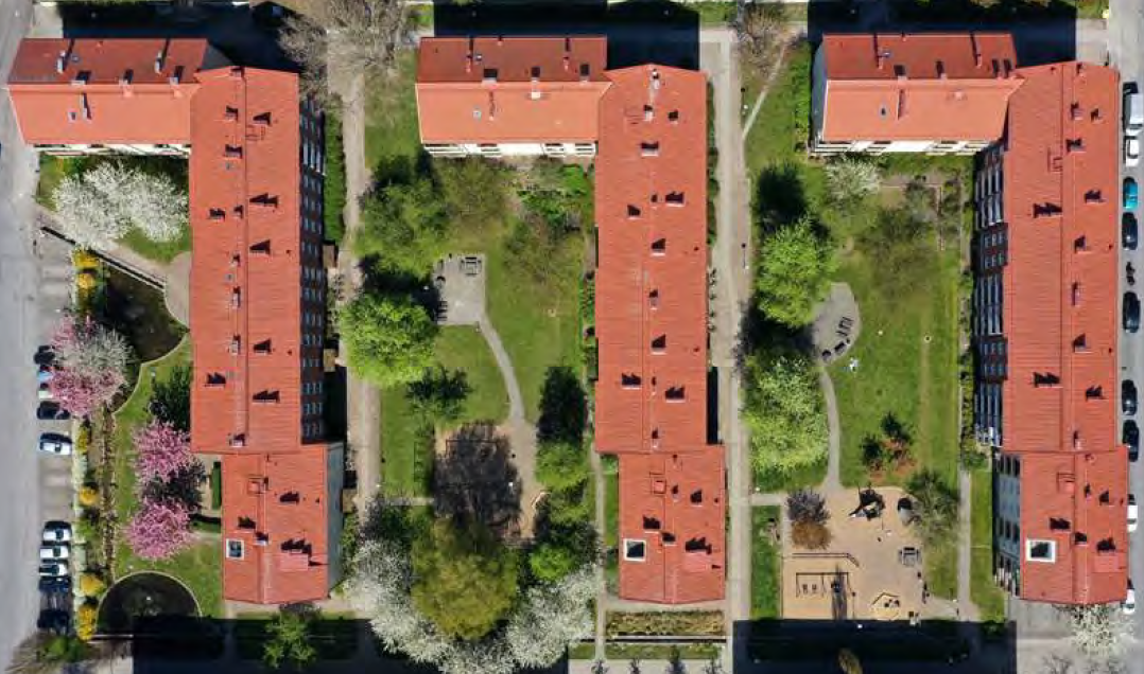
Image: The Eco-city Augustenborg, eds Monika Månsson and Bengt Persson, 2021.