
Speaking out for Landscape - Oral History and Landscape Architecture
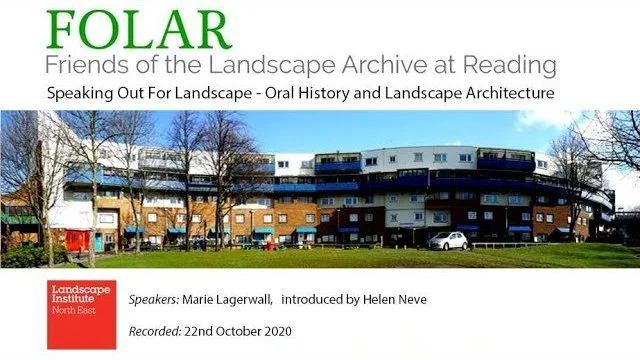
FOLAR is launching a new oral history project to capture the memories and experiences of landscape architects. But how is oral history relevant to practising landscape architects? Who have we already got on tape? Who should be on the new list to be interviewed? Who else is interested in our spoken histories? What significant projects should we cover that have not made it into the journals or received awards? With funding from the Landscape Institute, FOLAR commissioned Marie Lagerwall to research and catalogue the landscape architecture and gardening oral histories that were in existence. The FOLAR Review of Landscape Oral Histories (pub 2019) was a mammoth undertaking meticulously executed, and of benefit for The MERL, the Garden Museum and for national and international landscape archives. Marie explains her methodology and her findings in the recording we invited her to present to FOLAR and LI NE.
Download documents
Creating and experiencing Byker’s playable landscapes
Sally Watson has a rich background having studied architecture, planning and worked as a curator with the RIBA on their drawings and archives collections. She uses oral histories to collect information about how the architect Ralph Erskine designed the Byker Estate, a social housing development, built in the 1970s in Newcastle, how it was constructed and settled and how the landscape was designed and played in. Personal and individual stories and accounts cannot be interpreted, guessed or assumed from looking at drawings or reading project files. Information about how a designed landscape is used and enjoyed, or ignored or attacked, is what every landscape designer needs to know, and over a few years after completion, to hear and see how good a job they have done.
In her presentation Sally discusses the range and quantity of material in the Ralph Erskine archive at the RIBA deposited there in the 1980s. She acknowledges the significance that the collection was saved and accepted by the RIBA as a complete archive. She has recorded some wonderful stories from residents and others about the adventure playground and the temporary playground, how the problem of fires was cracked, of working with children, what people thought of the management and maintenance of the planting when they first moved in and later on. Her oral history research contributed to her PhD at University of Newcastle.
Telling stories, public history, living archives
Colin Moore explains his vision selecting some projects from the growing Landscape Institute collection at The MERL and using these as examples to show and tell the history of the site before, during and after a project has been designed and built. There is potential for many layers of more information to be added to this including oral histories from local residents. Making this information available, and digitally, to anyone who is interested is a key part of his idea. This needs to be set out in an engaging and entertaining way and at all sorts of levels. It should be possible for anyone to be able to contribute further information about a place. The key interest is about people and their emotional response to places.
Colin presents Michael Brown’s landscape design for the Brunel Estate in London as an example. Colin worked on this estate during its construction, and visited many times afterwards. He explains how the design and design details work, what the intention was. He also shows where some elements have been replaced and changed. How did this happen ? He finds out and tells us. Some elements have been restored and as closely to the original as possible - how did that happen and who made that happen? We find this out too. And then there are some parts eg play areas which have been partially filled in to make them less scary (or less risky?) but with other elements eg more railings added that were not originally intended and how these may indeed be more risky for children playing.
The landscape designers intention is rarely recorded and for landscape managers who work on sites long after the designer has died, this can be even more difficult.
Videos
(in order, from left to right)
Speaking out for Landscape by Marie Lagerwall
Creating and experiencing Byker’s playable landscapes by Sally Watson
Telling stories, public history, living archives by Colin Moore
[COVID has resulted in the postponement of this project but we hope to get on with this as soon as we can.]
Speakers: Marie Lagerwall, Sally Watson, Colin Moore
October 2020 online FOLAR AGM and FOLAR + LINE (Landscape Institute North East Branch) event