

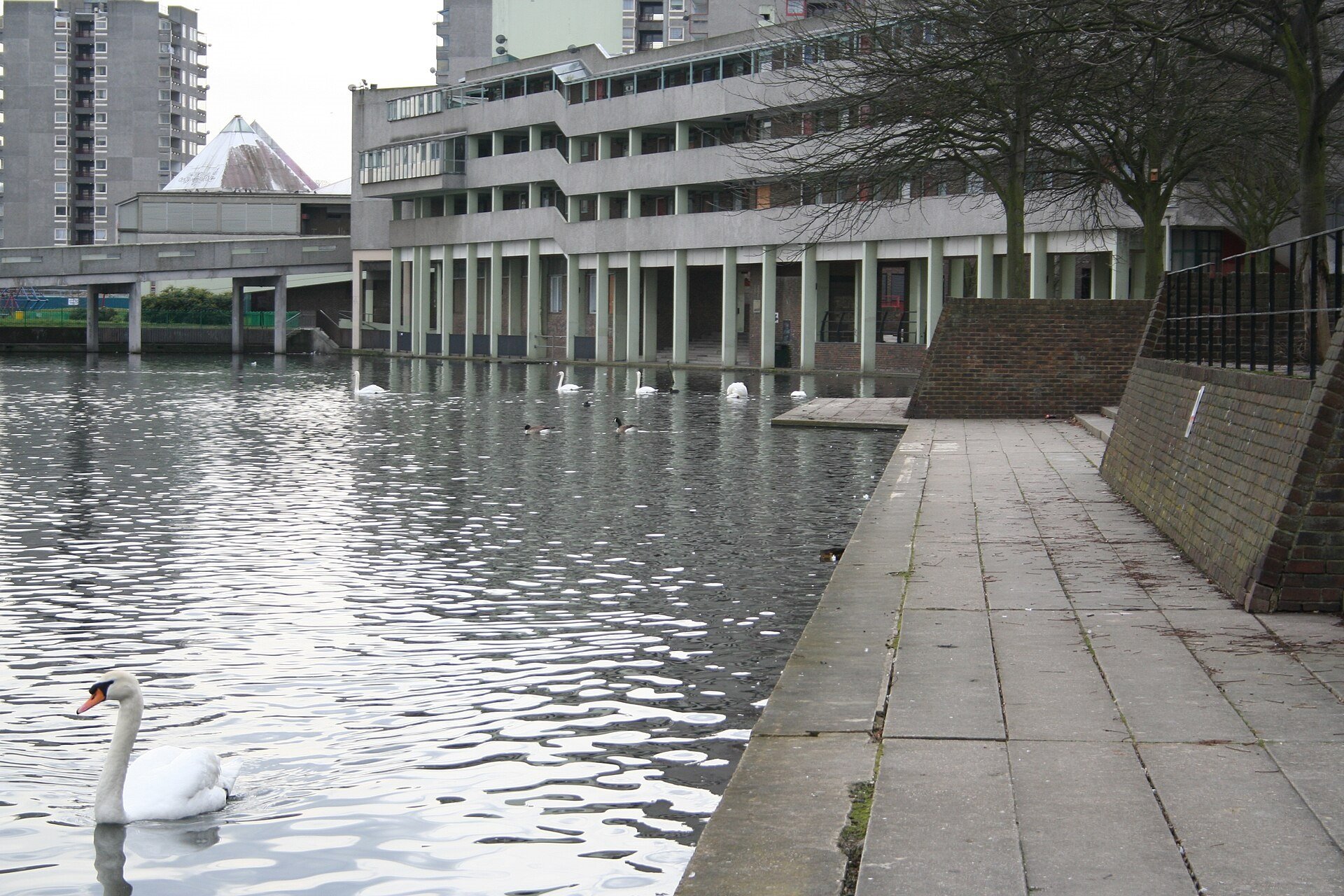
Thamesmead Housing Estate, Architect: G.L.C Department of Architecture and Civic Design; Image Jon Bennett (2006); CC BY 2.0
About: In 1986, the Greater London Council (GLC) (1965-1986) was abolished by the government of Margaret Thatcher, marking the end of a powerful era in London’s metropolitan governance. Yet, four decades later, the GLC’s contribution to the design of London’s landscapes—its parks, housing developments, civic spaces, and environmental policies—continues to shape the daily life and character of the capital.
This conference marks the 40th anniversary of the GLC’s demise by critically reassessing its role in landscape architecture, urban design, and public policy. The GLC’s in-house architects, planners, and landscape architects fostered a distinct civic design culture—progressive, socially engaged, and ambitious in its scope. This culture was reflected within the Green Belt policy; the two new Metropolitan Parks (Burgess Park and Mile End Park) and Metropolitan Parks generally, such as Hampstead Heath or Crystal Park; the Regional Parks, i.e. Lea Valley Regional Park, Colne Valley Regional Park, and the Havering Country Park. The GLC also proposed new towns, i.e. the aborted Hook, and half-born Thamesmead. In addition, there were expanded towns such as Hastings and Bletchley, as well as the GLC support for New Ash Green. And of course, there were the Thames Barrier flood defences. Finally in 1982, late in the GLC history, was the appointment of David Goode as Senior Ecologist with an afterlife, post 1986-2000, as the London Ecology Unit with Jacklyn Johnston as its landscape architect. From riverside parks and green corridors to housing landscapes and urban renewal projects, the GLC’s legacy remains visible, though often overlooked.
The contributions reflect on a large number of issues, many of which remain current an provide wider lessons for local authorities generally:
The role of landscape architecture and open space planning in local authorities
Parks, green spaces, and recreation in the post-war era
Housing landscapes and the integration of architecture and open space
The role of local authority’s Architecture, Planning and Development departments
The politics of design under local government
Public participation and community landscape projects
Gender, class, and labour in the local authority design teams
Comparisons with other metropolitan authorities in the UK and abroad
The dismantling of metropolitan governance and its design consequences
Local authorities’s environmental and ecological policies
Archival and oral histories of local authority projects and designers
Programme
10:30 Registration and coffee
11:00 Welcome and introduction to FOLAR - Annabel Downs
11:10 Chair - Ruth Lin Wong Holmes - introduction to conference
11:20 Open space planning in London before, during and after the Greater London Council - Tom Turner
11:50 Nine Years at the GLC - John Medhurst
12:20 The GLC’s urban landscape plan: where best to locate tall buildings - Tim Catchpole
12:50 Lunch
13:50 Landscape for housing and a master plan for Mile End Park - Mark Loxton
14:20 Landscape architects in the GLC’s Department for Recreation and Arts - Marie Burns and Annie Coombs
14:50 The ecology work of the GLC and the London Ecology Unit (1986-2000) - David Goode
15:20 Tea
15:40 Panel discussion: Reminiscences, recollections and questions, with David Foreman as additional contributor
16:30 Close
Online: Liz Lake, ‘My time at the GLC’
Location
The Alan Baxter Gallery, 70 Cowcross Street, London EC1M 6EJ
Abstracts
TOM TURNER - OPEN SPACE PLANNING IN LONDON BEFORE, DURING AND AFTER THE GREATER LONDON COUNCIL
This talk will consider three precursors and then the GLC candidate for the accolade of 'London's Greatest Open Space Plan.' Its predecessors were: Henry VIII, who deserves to be remembered at least as much for his work on parks as for his six wives; John Claudius Loudon, who gave little time to the subject but produced a visionary plan of the first order; and Patrick Abercrombie, who was a member of the ILA's council when drawing up his 1943 plan. They were great plans. But none was backed by anything like the research or the resources of the GLC's 1969 Greater London Development Plan.
Tom Turner is a retired landscape architect who taught at Greenwich University. He has been researching and publishing about the work of the landscape profession's intellectual founder: J.C. Loudon. He was involved in a study and analysis of the GLC’s work for a report entitled Towards a Green Strategy for London. This included plans for the Outer London Loop Walk while other proposals were later taken forward by landscape consultants LDA. Tom is the author of several books including one on landscape planning.
JOHN MEDHURST - 9 YEARS AT THE GLC
John spent two years in the LCC Park's Departments Housing Landscape group in the early 1960s, followed by two years in the Town Development Landscape Group in the Architect's Department later in the same decade, before finishing his career in local government in the late 1970s with five years again at the GLC as the group leader of the same group. Work included landscape proposals for expanding towns, rehabilitation of older GLC estates and the canal side parks programme. This talk recalls memories of people, events and of projects completed during that time and elaborates on the personal dynamics at this stage of the life of the Landscape Group.
John Medhurst studied horticulture at the Kent Horticultural Institute, Swanley, before beginning a course in Landscape Architecture at the Bartlett School of Architecture in 1962. In the same year he began working in the LCC Parks Landscape Group under Anthony Hedley Richmond. He left the LCC in 1963 but returned in 1966 to join the GLCs Town Development Landscape Group which was led by Michael Ellison, and he was responsible for the landscape proposals in three East Anglian towns. In 1968 he again left County Hall for the London Borough of Lambeth but in 1975 returned to take over as Head of the Landscape Profession when Michael Ellison left to work for the Department of the Environment, only leaving to form his own practice when Margaret Thatcher disbanded the GLC in 1986.
TIM CATCHPOLE - THE GLC’S URBAN LANDSCAPE PLAN: WHERE BEST TO LOCATE TALL BUILDINGS?
When the GLC took over the responsibilities of the LCC in 1965 covering a much wider area, one of its tasks was to produce a Greater London Development Plan (GLDP). Such a plan had to include an update of the LCC’s policies on London’s urban landscape and on the location of tall buildings which had begun with a few isolated towers in the 1950s and were now rampant. The GLC produced an Urban Landscape Plan showing constraints such as Areas of Special Character, corridor vistas of St Paul’s Cathedral and telecom channels where tall buildings should be refused, and opportunity areas where they could be allowed. However, the DoE Inspectorate did not accept the Plan as such and recommended that it should be diagrammatic so that the London boroughs can do the fine-tuning. The upshot was the GLDP’s pixellated Urban Landscape Diagram which, following final approval of the GLDP in 1976, was put to the test at a number of public inquiries and was found to be a useless tool for determining whether tall buildings should be allowed or refused because of the lack of fine-tuning.
Following the Abolition of the GLC, the successor bodies, namely LPAC, the DoE and English Heritage, commissioned a study to ensure this problem was solved. The study in 1988-89 in effect resurrected the original Urban Landscape Plan which had not been accepted earlier by the DoE Inspectorate and updated it. Based on this the DoE went on to identify nine views that were subsequently given protection by the Secretary of State in 1992. However, when the GLA came into being in 2000, the urban landscape of London started to change dramatically. Why? Who changed it? And has it been a successful change?
Tim Catchpole joined the GLC in 1975 and worked in its Planning and Transportation Department. He participated in three tall building inquiries, managed a blueprint study of the total length of Thames-side and authored a report on the future of the Thames Barrier construction sites. Following Abolition, he authored the above-mentioned study for LPAC, DoE and English Heritage. He then joined Halcrow Fox in 1989 and worked in its international Planning Team, ultimately in charge of oil and gas projects. Since retirement in 2014 he has resumed interest in the planning of London, particularly Thames-side.
MARK LOXTON - LANDSCAPE FOR HOUSING AND A MASTER PLAN FOR MILE END PARK
In considering the legacy of the Greater London Council (GLC), it may be helpful to reflect on the scale of development that was undertaken from the founding of the London County Council (LCC) in 1889 to the abolition of the GLC in 1986. The GLC operated from 1965 to 1986. The projects that were undertaken during this period ranged from new housing estates, local and district parks, schools, hospitals, roads and major engineering facilities such as the Thames Barrier. Although I worked for the GLC for over 2 years my reflections are in two parts.
The first was as a very young student aged 20 having won a scholarship with the GLC Parks Department starting in late 1967. Work was divided between tasks undertaken in the office for 4 days and attending a day release course at Hammersmith College of Art and Building (now Greenwich University London). As the understudy to a qualified Landscape Architect, projects mainly focused on housing developments from concept, detailed design and supervision of construction. The rapidity of housing provision and completions was impressive, with a multi-disciplinary approach involving surveyors, architects and engineers. Although I completed a successful probationary year I decided to attend a full-time course in Landscape Architecture at Manchester Art College.
The second time working for the GLC was from 1979 to 1980. Working again for the Parks Department but this time as a Team Leader in County Hall. One of the main tasks for the team was the submission of a master plan for Mile End Park to the Council members who then passed a resolution that the park was to be completed in its entirety in accordance with the 1943 County of London Plan and subsequent strategic policies. The new district park formed part of an open space system following the “maldistribution and deficiencies” of post war London. This would involve the clearance of bomb damaged derelict sites and the compulsory purchase of industrial land and houses. Burgess Park in south London was designed and completed at the same time as Mile End Park. From my experience the GLC achieved much despite the continued political difficulties and its final demise and subsequent replacement by the Greater London Authority (GLA) in 1986. It is noted that the GLA has not met the 2021-2026 target for affordable homes and no new district parks such as Mile End Park and Burgess Park have been built.
Mark Loxton started his career with a year’s scholarship with GLC in 1968. He then studied Landscape Architecture and Design at Manchester College of Art under Rex Fairbrother, leaving with a First Class Honours in 1972. His first job was with Atkins Sheppard Fiddler in Cardiff followed by Brian Clouston and Partners in London, a very happy six years up to 1979. A second period working for the GLC 1979 - 1980 in the Parks Department in County Hall. At the end of 1980 he joined Shankland Cox, an international Planning Consultancy. He became a director in 1981 setting up a Landscape Division within this multi-disciplinary firm. In 1990 he started his own practice, joining forces with Robert Adams to form The Adams Loxton Partnership Ltd in 1991. ALP was incorporated into Boon Brown, a firm of Planners, Architects and Landscape Architects in 2018. Mark continued to support Oliver Clark, Boon Browns Director of Landscape Architecture, retiring in 2022. Mark has worked and undertaken projects in many counties including Hong Kong, Malaysia Oman, UAE, Kuwait, Cyprus and Russia. The many projects undertaken range from large-scale reclamation to designs for New Towns and parks.
MARIE BURNS AND ANNIE COOMBS - LANDSCAPE ARCHITECTS INTHE GLC’s DEPARTMENT FOR RECREATION AND ARTS
This session will reflect on the range of projects that the speakers worked on while at the GLC, how the landscape office and wider organisation appeared to these landscape architects, and how that experience influenced their subsequent respective careers.
They were fortunate to be involved with the design and delivery of large-scale open space projects that benefitted the local communities and London as a whole. This was at a time when the role of landscape architecture was seen as the focus of urban regeneration within neighbouring European cities.
The Open Space Section, as it was known, was based on a multidisciplinary approach to achieving innovative designs and their realisation on site. As such these young landscape architects were given a wide scope in progressing design opportunities and were supported by an experienced team of professions: civil, structural and electrical engineers, quantity surveyors, architects, clerk of works and contractors.
Marie Burns was previously a qualified landscape architect, urban designer and transport planner, having a master’s degree in urban design and a master’s degree of philosophy, which explored how innovative transport systems can be a catalyst to reinvent cities through their public realm. She worked for the GLC as a landscape architect from 1978 until its closure in 1986. The projects Marie was involved with included Burgess Park, South Bank rejuvenation, Jubilee Gardens, Riverside Walk and Coin Street, the Peace Pagoda at Battersea Park and the ecological regeneration of Hounslow Heath. During that time, she organised trips for the Southeast Chapter of the Landscape Institute to European cities to visit public realm schemes, talk to the designers and to bring that experience back to practice here.
After the GLC, Marie moved into private practice before establishing Burns + Nice in 1997 (with fellow ex GLC landscape architect Stephen Nice). The practice focused on the master planning, design and implementation of public realm and landscape schemes, many of which were award winning, including the Landscape Institute’s President’s Award for the Redesign of Leicester Square.
She has served on Local Authority Design Panels and has given talks at universities and international conferences. Marie was also commissioned by the RIBA to write the book New Life in Public Squares, (2020), which looked at how urban squares can revitalise existing places or provide a sense of place to new urban quarters.
Annie Coombs is a landscape architect with a master’s degree in planning. Annie’s career started in the public sector at Liverpool for Merseyside County Council and for the GLC in London from 1978 to 1980. She subsequently worked in Asia for sixteen years, peaking as managing director of the Clouston Asian business. She was responsible for offices in Hong Kong, Singapore and Kuala Lumpur and returned to the UK as board member of an environmental management company following integration of the Asian Clouston business. Her main project focus in Asia was on large scale infrastructure projects; reclamation, roads, rail, ports and the replacement airport in Hong Kong.
On return to the UK in 1997, Annie focussed on infrastructure and good design. She worked as a CABE enabler and was appointed as a Commissioner of the Infrastructure Planning Commission and has examined nationally significant infrastructure projects. She chairs and sits on design review panels. She is a chair of the Northwest design panel, a Design Council Ambassador, one of three chairs for the Heathrow Expansion panel and formerly one of two deputy chairs of the HS2 independent design panel. She has volunteered for the Landscape Institute on policy for nearly 30 years.
DAVID GOODE - THE ECOLOGY WORK OF THE GLC AND THE LONDON ECOLOGY UNIT
In 1982 I was appointed as Senior Ecologist in the Greater London Council. My role was to bring Ecology into all aspects of the Council’s work. When I started, there was no mention of Ecology or Nature Conservation in the Council’s activities. So I embarked on an innovative program for nature conservation within Greater London. Its purpose was to protect and enhance London’s natural areas and their associated species, and to make it possible for Londoners to have greater contact with nature in their everyday lives. The program involved many different players, including official agencies, voluntary bodies and many other organisations, supported by a groundswell of public opinion that was exceedingly valuable. Together, they have generated a new consciousness and a very effective program of action. My new approaches had a strong social dimension that may at first have seemed a radical departure from traditional nature conservation. However, the whole approach has since been adopted as an integral part of city management when it formed the basis of the statutory Biodiversity Strategy for the capital, launched by the first elected Mayor (Ken Livingstone) in 2002.
The project has five main elements. At its heart is the social dimension, the objective being to enable all who live or work in London to have greater contact with nature in their own locality. Second, but fundamental to the whole approach, is the system for protecting London’s important wildlife habitats. This has resulted in over 1500 sites being scheduled for protection through the statutory planning process. This represents about 1/5 of the area of Greater London. The system also enables districts that are deficient in accessible wildlife sites to be identified. These are parts of London where special action needs to be taken to create new wildlife habitats that will enable people to maintain daily links with nature. Habitat creation is the third main element of the program. This includes ecological enhancement of public parks and open species or creation of entirely new wildlife habitats for public enjoyment and environmental education. It also includes design for biodiversity within the fabric of the built environment. The fourth element is education, encouraging provision of facilities for environmental education and opportunities for all sectors of society to be actively involved in environmental projects. The last element is partnership. The program could not be achieved without a wide range of organisations and individuals working together to a common goal. This has been organized through the London Biodiversity Partnership.
David Goode was Senior Ecologist at the Greater London Council (1982-86) and subsequently Director of the London Ecology Unit (1986-2000) and Head of Environment for the Greater London Authority (2000-2004). Alongside these positions he held several senior positions in Voluntary Bodies: Chair and Vice-President: of the UK Tree Council; Board Member of the National Forest; Vice Chairman of the Trust for Urban Ecology, and Vice President and President of the Institute of Ecology and Environmental Management
PANEL DISCUSSION: REMINISCENCES, RECOLLECTIONS AND QUESTIONS, WITH DAVID FOREMAN AS ADDITIONAL CONTRIBUTOR
David Foreman joined the Landscape Group in the Town Development Division of the Architects Department of the Greater London Council on 5th September 1965. The Town Development Division was the only division which had its own Landscape Group, the other divisions were served by the GLC Parks Department. The Division dealt with the GLC’s programme of new and expanding towns outside London. The new housing schemes that he worked were in Andover, Bletchley, Sudbury, Thetford and Sandy. He occasionally worked on projects in London, such as housing in Islington, Aveley, Coin Street and a canal side community park at Meanwhile Gardens. In 1982 he joined the Thamesmead Landscape Group in the Parks Department and in 1986 when the GLC was abolished he was recruited to join the new landscape group in Thamesmead where he stayed until late 1999. He subsequently set himself up as a consultant working mainly on inner London housing regeneration projects, in particular the Aylesbury Estate in Southwark that included major regeneration and improvements to Burgess Park. He assisted in the appointment of LDA Design to design and carry out the project.